

Jason’s credit-card repayments had been putting pressure on his cash flow for more than three months.
His credit-card debts kept putting pressure on the month. He was making payments, but he needed a way to reduce the commitments and get room to move again.
Jason is not his real name. I shared his case in June 2023, and I want to take you through how we worked out which debts to focus on and what changed.
If you are earning well but still short every month, this is the part I want you to notice: we started by diagnosing his situation before choosing a consolidation plan.
Step 1 was to understand where he was overcommitted
I used ICE JAR to organise his income and outflows. The one-third reference gave us a way to see which allocation needed attention.
Jason’s Commitment Jar was RM1,348 a month above its reference.
That told me to look more closely at his repayments. Let me show you the original ICE JAR illustration, so you can see where the RM1,348 came from. It is the excess in his Commitment Jar against its reference, rather than a calculation of his total household deficit.
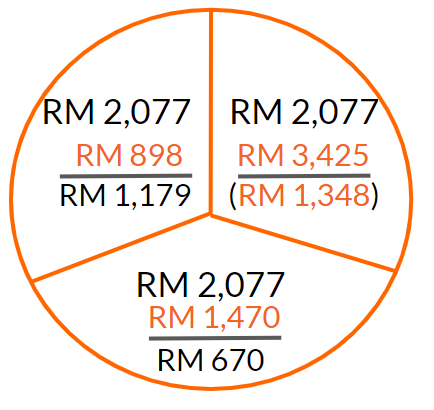
| Jar | Reference shown | Outflow shown | Difference |
|---|---|---|---|
| Investment | RM2,077 | RM898 | RM1,179 remaining |
| Commitment | RM2,077 | RM3,425 | RM1,348 over |
| Expenses | RM2,077 | RM1,470 | RM607 remaining |
Now you can see why I looked inside his commitments. The three displayed outflows add up to RM5,793, while the three references add up to RM6,231. This picture demonstrates an overcommitted jar; it does not, by itself, establish an overall household deficit. The original image’s Expenses remainder reads RM670, but RM2,077 less RM1,470 is RM607, as reconciled in the table.
If you have not done this exercise, read my ICE JAR article first. It will help you organise your own numbers before comparing facilities.
Step 2 was to look inside the commitments
Using my Debt Management Template, we listed what he owed and what he was paying.
Two areas stood out:
| Debt | Outstanding balance | Monthly payment |
|---|---|---|
| Two credit cards combined | RM16,000 | RM1,500 |
| PTPTN | RM14,753 | RM164 |
Look at those balances first. RM16,000 and RM14,753 are not far apart.
Now look at the monthly payments: RM1,500 compared with RM164.
That difference mattered because Jason needed cash flow relief.
Using IBR, which I explain in James’s story, the card payments came to about 9.38% of their balance. PTPTN came to about 1.11%.
Can you see why the credit cards became our focus?
The biggest balance is not always the one putting the greatest pressure on the month. You need to look at the payment attached to it too.
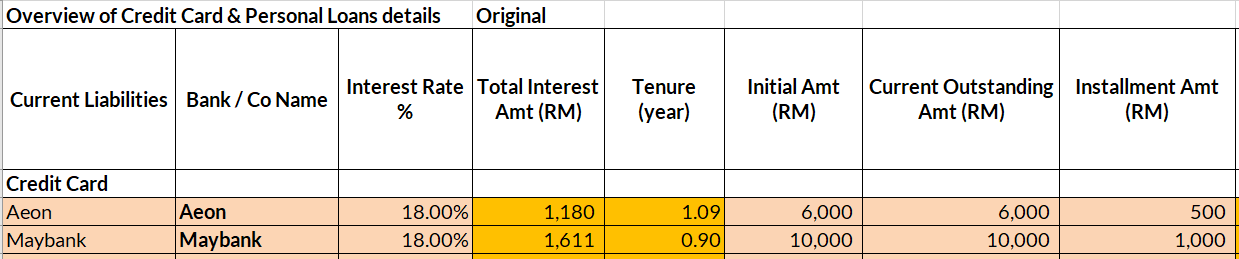
| Card | Balance | Monthly payment | Rate shown | Estimated interest |
|---|---|---|---|---|
| Aeon | RM6,000 | RM500 | 18% | RM1,180 |
| Maybank | RM10,000 | RM1,000 | 18% | RM1,611 |
| Total | RM16,000 | RM1,500 | — | RM2,791 |
Step 3 was to formulate a strategy
The strategy was to consolidate the two card debts into one repayment arrangement.
We did not put PTPTN into the plan simply because it was another debt on the list. It had to be assessed on its own terms.
That is something I want readers to understand about consolidation. One payment can be easier to manage, but convenience alone is not enough reason to move every debt.
Start with the pressure you need to solve. Then ask which balances need to change and whether the proposed arrangement improves the overall position.
Step 4 was to compare and take action
Jason contacted several banks and compared the plans available to him.
The new arrangement in the original case worksheet ran for 36 months, with a monthly payment of RM491.17. Compare that with the RM1,500 he had been paying across the two cards.
That freed up RM1,008.83 a month.

Jason’s monthly card-repayment comparison
Monthly repayment reliefRM1,008.83
Two card balances combined into the arrangement shown in the case. Compare the total cost and the full monthly budget too.
He also had a single payment to manage for the two card balances. That gave him more room in his monthly cash flow and the opportunity to rebuild savings.
Of course, the room created needed to be managed. If he built up the cards again while the new repayment continued, he would have another problem to deal with.
A lower quoted rate still needs a proper comparison
The June 2023 worksheet quoted 18% for the cards and 7% for the new arrangement. I want you to look at the repayment and total-interest figures too. This connects with something I teach: low interest rate does not automatically mean low total interest.
You need to understand how the rate is calculated and how long you will be paying.
The original card worksheet estimated interest of RM1,180 + RM1,611 = RM2,791. The consolidation worksheet estimated RM1,682.06. That is an estimated difference of RM1,108.94 in those historical worksheets, alongside the RM1,008.83 monthly repayment relief.
Those are worksheet projections from this case, rather than a current bank quotation or a guarantee of actual interest savings. The rate calculation, fees, future card use and actual repayment schedule affect the result. Multiplying the displayed RM491.17 by 36 gives RM17,682.12; its six-sen difference from the worksheet total illustrates why rounded monthly figures need care.
So do not choose a plan just because one percentage looks smaller than another. Ask for the repayment schedule and the effective annual interest or profit rate, and understand any fees as part of the comparison.
What I would look at with you
First, how much do you actually need to settle? Get the current settlement figures. If an offer includes extra cash, show that separately so you can see the cost of the additional borrowing.
Next, what are the monthly repayment and the total scheduled repayment? Check the term, the fees, whether the payment can change and what happens if you settle early.
If property is being used as security, understand what is being put at risk. Moving card debt into a property-backed arrangement changes the consequences if you later cannot pay.
Then come back to ICE JAR. Replace the old payments with the proposed one and review the full month again.
Is there enough left for living costs and irregular bills? What happens in a weaker income month? Can you get through without borrowing on the cards again?
In Jason’s case, the RM1,008.83 repayment relief was smaller than the RM1,348 excess identified against his Commitment Jar reference. So there was still more allocation work to do.
That is why I want to see the whole picture, rather than judge a plan by the new instalment alone.
Start where Jason started
Are you overcommitting, overspending or overinvesting?
Use ICE JAR and the Debt Management Template to put the numbers together. If your card balances keep growing despite regular payments, Isabela’s story may help you spot what is happening.
If you want help understanding whether consolidation is a direction worth exploring in your situation, come through Money X-Ray.
Let’s start by understanding your monthly pressure and the options that fit the case.
Jason is a pseudonym. This is an actual historical case, with terms available to him at the time. It does not guarantee another reader the same repayment, financing approval or outcome.
P.S. AKPK offers financial counselling and a debt-management programme. My work starts with diagnosing your full financial picture and assessing an appropriate direction through Money X-Ray. Depending on your circumstances, that may involve education, coaching or DCS4U support, including suitable options outside enrolment in AKPK’s debt-management programme. A new facility is not the answer for every case; the assessment comes first.
From my original articles
Adapted from my June 2023 Jason case, with its three original illustrations. Rates, terms and total-interest figures are historical worksheet projections.